Impact of Transportation Infrastructure on Vietnam’s Industrial Park Market
Vietnam’s industrial park market is entering a strong growth phase, attracting billions of USD in Foreign Direct Investment (FDI). A key factor determining the appeal of industrial parks is transportation infrastructure. Highways, seaports, airports, and railways affect logistics costs and determine the strategic location of each industrial park. How is transportation infrastructure currently impacting the Vietnam industrial park market?
1. The Foundation Infrastructure of Industrial Parks
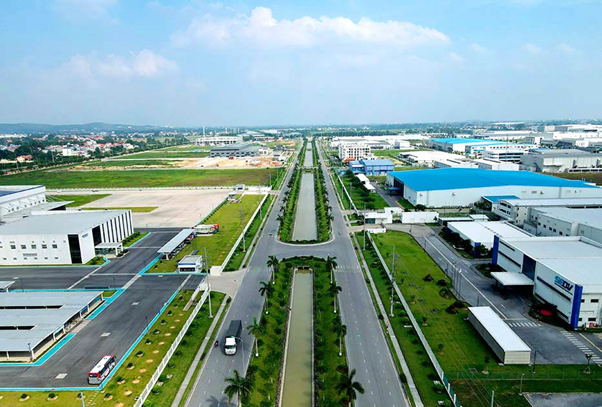
Transportation infrastructure is considered the backbone of the industrial economy. Because there is a need for connection between factories, seaports, airports, and consumption centers, industrial parks are only attractive when they have synchronized transportation.
- Highways: Shorten transport time and reduce logistics costs.
- Seaports: Export gateways for goods, especially important for electronics, textiles, and footwear.
- International Airports: Convenient for transporting high-value goods that require speed.
- Railways: Aimed at moving large volumes of goods and regional connectivity. Therefore, every new transportation project can change the industrial park market within a radius of hundreds of kilometers.
2. Current Transportation Infrastructure and its Impact on Vietnam’s Industrial Parks<
2.1 The North
The North has advantages with deep-sea ports (Lach Huyen – Hai Phong), Noi Bai International Airport, and modern highway networks like Hanoi – Hai Phong, Hanoi – Thai Nguyen, Noi Bai – Lao Cai, and Hanoi – Vinh Phuc.
Industrial parks in Phu Tho, Bac Ninh, and Hai Phong benefit directly, becoming “electronics industrial hubs” due to their proximity to the sea and border gates.

Industrial land rental prices in the North remain at 130–145 USD/m²/lease cycle. This is high but still attractive due to good logistics infrastructure.
2.2 The Central Region
The Central region is confirming its position with North-South highway routes, Tien Sa port (Da Nang), Vung Ang deep-sea port (Ha Tinh), and international airports like Da Nang, Chu Lai, and Phu Bai.
Industrial parks like Hoa Ninh (Da Nang) and Vung Ang (Ha Tinh) attract investment in heavy industry, energy, and logistics near seaports.
However, some provinces still face limitations in regional connectivity, leading to lower rental prices, averaging 50–70 USD/m²/lease cycle.
2.3 The South
The South is considered the area with the most developed industrial infrastructure in the country, supported by Cat Lai, Cai Mep – Thi Vai port systems, Tan Son Nhat Airport (and future Long Thanh), and the highway network like HCMC – Long Thanh – Dau Giay and Ben Luc – Long Thanh.
Binh Duong, Dong Nai, Long An, and Ba Ria – Vung Tau are large industrial centers.
Industrial land rental prices in the South average 180–200 USD/m²/lease cycle, the highest in the country, reflecting the appeal of transportation infrastructure and a complete supply chain.
3. Transportation Infrastructure’s Impact on Rental Prices and Occupancy Rates
Transportation infrastructure directly affects land rental prices and occupancy rates at industrial parks.
Industrial parks near seaports, highways, and airports have rental prices 20–30% higher than areas far from the center.
Occupancy rates at industrial parks near main transport axes reach 85–95%, while areas with less convenient infrastructure only reach about 60–70%.
Ready-built factories (RBF) near ports or highways always fill up faster due to high demand from FDI enterprises.
4. Vietnam Transportation Infrastructure Outlook 2025–2030
The Government aims by 2030 to:
- Complete 5,000 km of highways.
- Expand deep-sea port systems in Hai Phong and Ba Ria – Vung Tau.
- Put Long Thanh and Gia Binh international airports into operation.
Increase investment in railways linking industrial parks and seaports. This outlook opens opportunities for new industrial parks, especially in areas with abundant land but previously poor transportation like Thanh Hoa, Nghe An, Thai Binh, Tay Ninh, and Binh Phước.
5. Role of Industrial Park Developers in Utilizing Transportation Infrastructure
Transportation infrastructure only works effectively when accompanied by strategic preparation from the industrial park developer.
Reasonable location: Choosing locations near main arteries.
Synchronized logistics services: Developing warehouses and logistics centers directly connected to highways, ports, and airports.
Technology application: Smart operational management and supply chain optimization. Businesses like CNCTech Industrial (CIS) are following this direction, developing green industrial parks linked to main transport axes to create sustainable competitive advantages.
6. Challenges and Requirements
Despite positive transportation infrastructure prospects, the Vietnam industrial park market still faces challenges:
- Construction progress: Many highway, railway, and seaport projects are behind schedule, affecting investment plans.
- Land and clearance costs: Increasingly high, especially in areas near major transport axes.
- Environmental pressure – ESG: Requirements to combine transportation infrastructure with sustainable development and carbon reduction.
Logistics human resources: A need for quality personnel to optimize new infrastructure.
Overall
Transportation infrastructure is the factor that decides the competitiveness of the Vietnam industrial park market. The development of highways, seaports, airports, and railways not only increases the value of industrial real estate but also attracts FDI. In the 2025–2030 period, with many important infrastructure projects being deployed, Vietnam has a breakthrough opportunity to become a new industrial-logistics center of the region.
For investors, choosing an industrial park must be linked to strategic transportation. At the same time, cooperating with reputable developers like CNCTech will help businesses optimize costs, shorten deployment time, and effectively use infrastructure benefits.
Contact for details:
🌐 Website: https://cisgroup.vn/
📞 Hotline: (+84) 866 505 509
📧 Email: hello@cisgroup.vn